
Introduction
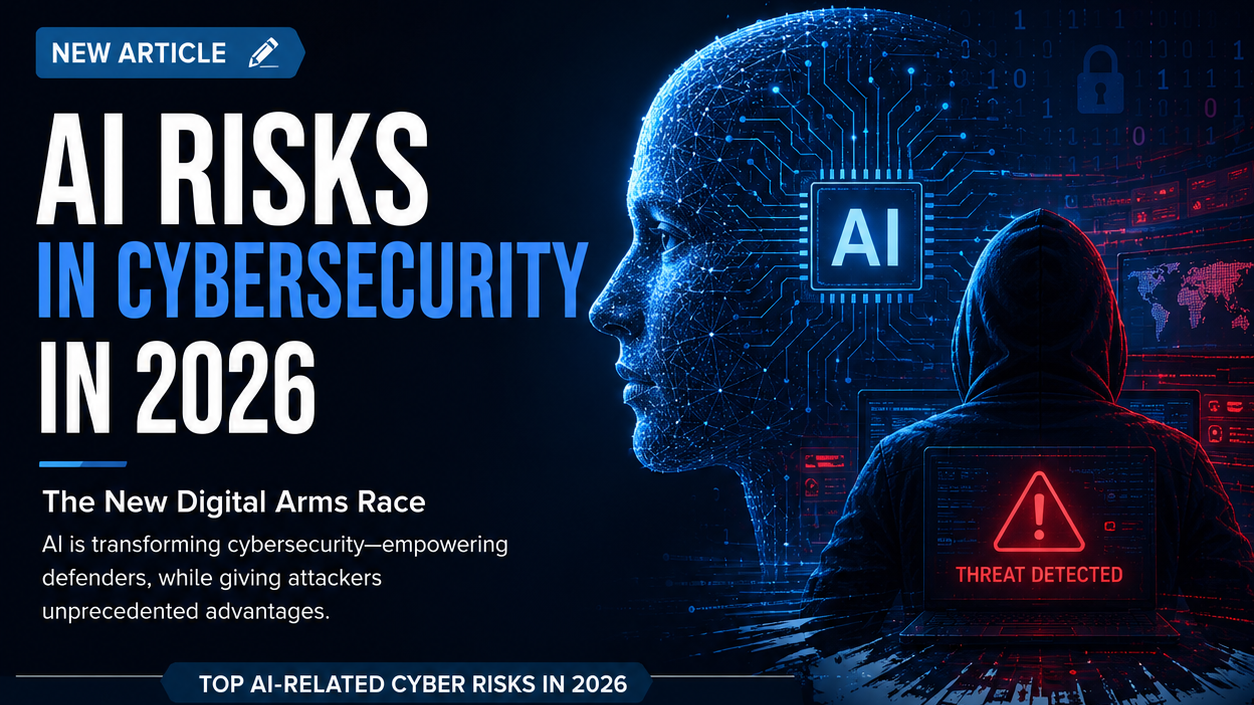
Artificial Intelligence (AI) has transformed cybersecurity at an unprecedented pace. In 2026, organizations worldwide rely on AI-powered tools to detect threats, automate responses, analyze vulnerabilities, and strengthen security operations. However, the same technology that empowers defenders is increasingly being weaponized by cybercriminals.
The cybersecurity landscape has evolved into an AI-driven arms race where attackers and defenders continuously compete to outpace one another. Organizations that fail to understand the emerging risks associated with AI may find themselves vulnerable to sophisticated attacks that are faster, more targeted, and more difficult to detect than ever before.
This article explores the most significant AI-related cybersecurity risks facing businesses in 2026 and outlines strategies to mitigate these threats.
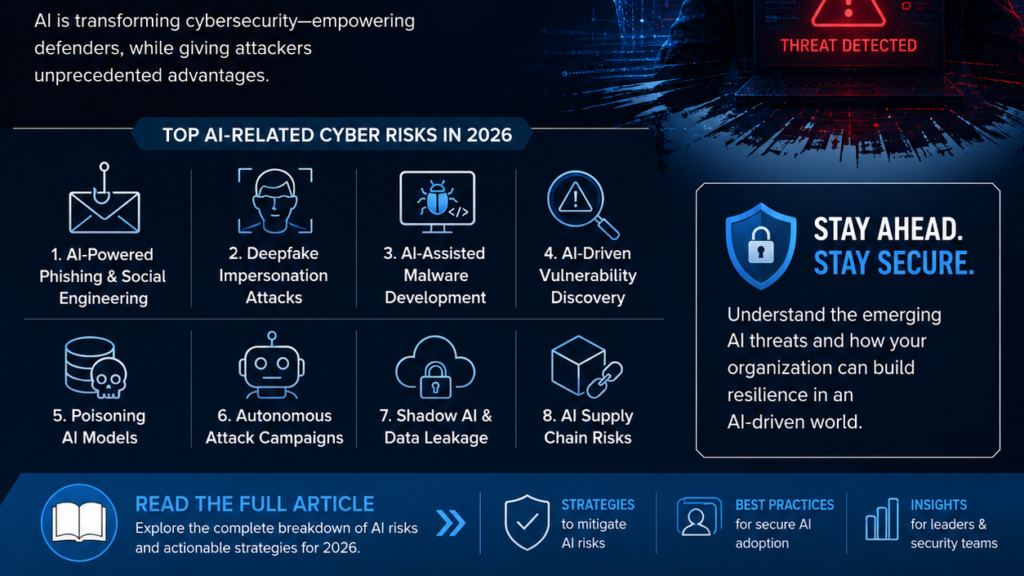
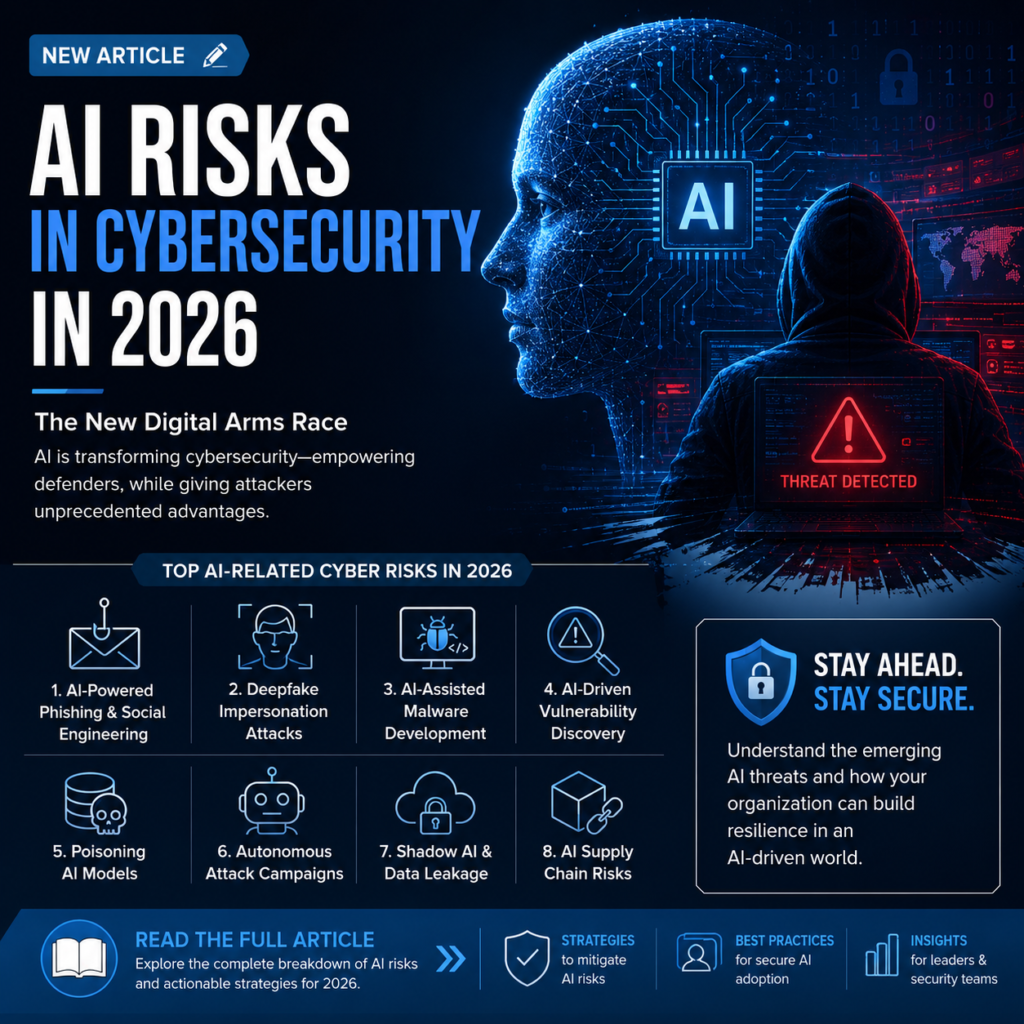
1. AI-Powered Social Engineering and Phishing Attacks
Traditional phishing campaigns often relied on poor grammar, generic messaging, and obvious indicators of fraud. In 2026, generative AI has largely eliminated these weaknesses.
Cybercriminals can now:
- Generate highly personalized phishing emails within seconds
- Mimic writing styles of executives and colleagues
- Create convincing business communications in multiple languages
- Conduct automated reconnaissance using publicly available information
AI-driven phishing campaigns leverage data from social media, corporate websites, public records, and previous breaches to create targeted attacks that are significantly more believable than traditional phishing attempts.
Business Impact
- Increased credential theft
- Business Email Compromise (BEC)
- Financial fraud
- Data breaches
- Reputational damage
Organizations can no longer rely solely on user awareness training to defend against phishing. Technical controls and behavioral analytics have become essential components of modern defense strategies.
2. Deepfake Impersonation Attacks
Deepfake technology has matured significantly by 2026. Attackers can generate realistic audio and video content capable of impersonating executives, employees, suppliers, and customers.
Common attack scenarios include:
- Fraudulent executive payment requests
- Fake video conference participants
- Voice-cloned helpdesk requests
- Social engineering of finance teams
- Customer identity fraud
Several organizations have already reported incidents where employees were deceived into transferring funds or sharing sensitive information after receiving AI-generated communications that appeared authentic.
Business Impact
- Financial losses
- Fraudulent transactions
- Executive impersonation
- Trust erosion
- Regulatory consequences
Organizations must increasingly verify requests through multiple communication channels and implement stronger identity verification procedures.
3. AI-Assisted Malware Development
One of the most concerning trends in 2026 is the use of AI to accelerate malware development.
Threat actors now use AI systems to:
- Generate malicious code variants
- Modify existing malware to evade detection
- Identify software vulnerabilities
- Create polymorphic malware
- Automate exploit development
While leading AI providers implement safety controls, cybercriminals frequently leverage open-source models or modified systems that bypass restrictions.
This has dramatically lowered the barrier to entry for less technically skilled attackers, enabling more individuals to launch sophisticated cyberattacks.
Business Impact
- Increased attack volume
- Faster malware evolution
- Reduced effectiveness of signature-based detection
- Greater ransomware sophistication
Security teams must increasingly rely on behavioral detection rather than static indicators of compromise.
4. AI-Driven Vulnerability Discovery
AI has become highly effective at analyzing large codebases and identifying weaknesses.
While defenders use AI to strengthen security, attackers are employing similar technologies to:
- Scan internet-facing systems
- Discover misconfigurations
- Identify vulnerable applications
- Analyze source code repositories
- Prioritize high-value targets
The speed at which vulnerabilities can be identified has significantly increased, reducing the time organizations have to remediate security issues.
Business Impact
- Shorter exploitation windows
- Increased zero-day exposure
- More targeted attacks
- Accelerated attack cycles
Organizations must adopt continuous vulnerability management and proactive threat hunting practices.
5. Poisoning AI Models
As AI adoption grows, organizations increasingly depend on machine learning models for security operations, fraud detection, customer service, and business decision-making.
Attackers are targeting these systems through:
- Training data manipulation
- Model poisoning
- Adversarial inputs
- Data integrity attacks
- Supply chain compromise
A compromised AI model can produce inaccurate results, conceal malicious activity, or influence business decisions.
Business Impact
- Reduced detection accuracy
- Security blind spots
- Compliance failures
- Business disruption
AI governance and model validation have become critical cybersecurity functions rather than purely technical concerns.
6. Autonomous Attack Campaigns
Cybercriminal groups are increasingly experimenting with autonomous AI agents capable of conducting portions of an attack without direct human intervention.
These systems can:
- Gather intelligence
- Scan networks
- Adapt attack strategies
- Generate attack content
- Coordinate multi-stage campaigns
Although fully autonomous cyberattacks remain relatively uncommon, semi-autonomous systems are becoming increasingly effective and accessible.
Business Impact
- Higher attack frequency
- Faster attack execution
- Reduced attacker costs
- Increased operational pressure on security teams
Organizations must enhance their automation capabilities to respond at machine speed.
7. Shadow AI and Data Leakage
The widespread use of public AI tools has introduced new risks for organizations.
Employees may unintentionally expose sensitive information by entering:
- Customer data
- Source code
- Financial records
- Strategic business plans
- Intellectual property
Without appropriate governance, organizations face significant risks related to confidentiality, privacy, and regulatory compliance.
Business Impact
- Data breaches
- Intellectual property loss
- Regulatory penalties
- Contractual violations
Strong AI usage policies and approved enterprise AI platforms are essential controls in 2026.
8. AI Supply Chain Risks
Organizations increasingly rely on third-party AI models, APIs, plugins, and cloud-based AI services.
Each dependency introduces potential risks including:
- Vulnerable models
- Malicious training data
- Compromised providers
- Insecure integrations
- Hidden model behavior
As AI ecosystems become more complex, supply chain security becomes increasingly important.
Business Impact
- Third-party compromise
- Expanded attack surface
- Operational disruption
- Compliance challenges
Vendor risk assessments must now include AI-specific security considerations.
How Organizations Can Reduce AI-Related Cyber Risks
To effectively manage AI risks in 2026, organizations should focus on five key areas:
1. Establish AI Governance
Develop clear policies governing:
- Approved AI platforms
- Data handling requirements
- Acceptable use guidelines
- Model lifecycle management
2. Strengthen Identity Verification
Implement:
- Multi-factor authentication
- Out-of-band verification
- Zero-trust principles
- Deepfake detection processes
3. Invest in AI-Powered Defense
Leverage AI for:
- Threat detection
- Security analytics
- Automated response
- Behavioral monitoring
4. Enhance Employee Awareness
Train staff to recognize:
- Deepfakes
- AI-generated phishing
- Social engineering techniques
- Data leakage risks
5. Continuously Monitor AI Systems
Regularly assess:
- Model performance
- Data integrity
- Security controls
- Third-party AI dependencies
Conclusion
The cybersecurity challenges of 2026 are no longer solely about protecting networks and systems – they are increasingly about managing intelligent technologies that can be used by both defenders and adversaries.
AI offers tremendous opportunities to improve security outcomes, but it also introduces new attack vectors, accelerates threat evolution, and lowers barriers for cybercriminals. Organizations that embrace AI without implementing robust governance, security controls, and risk management frameworks may expose themselves to significant vulnerabilities.
Success in the modern cybersecurity landscape requires a balanced approach: leveraging AI’s capabilities while remaining vigilant against the risks it creates. Those who can effectively manage this balance will be best positioned to thrive in an increasingly AI-driven digital world.
Note: This article is written at an executive and business leadership level, making it suitable for CIOs, CISOs, Service Delivery Leaders, Managed Service Providers, and cybersecurity consultancies looking to educate clients on emerging AI threats in 2026.