
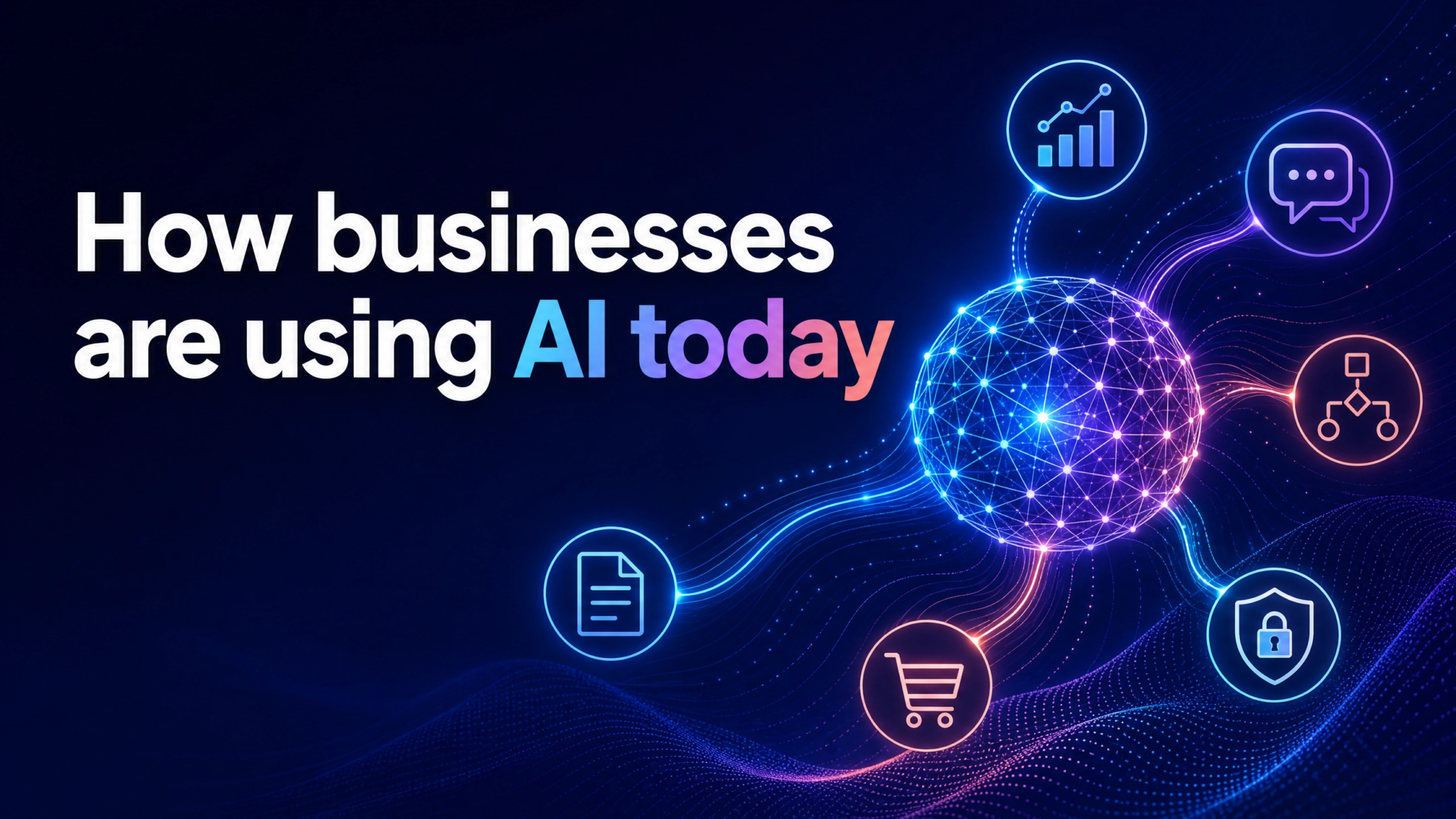
How Businesses Are Using AI Today
Artificial Intelligence has moved from a futuristic idea to a practical business tool. Companies of all sizes are using AI to automate routine work, analyze information, improve customer experiences, and support better decision-making.
One of the most common applications is customer service. AI-powered chatbots and virtual assistants can answer frequently asked questions, track orders, schedule appointments, and provide support around the clock. This allows employees to focus on more complex customer needs while reducing response times.
Businesses are also using AI to work more efficiently. Generative AI tools can draft emails, summarize meetings, create reports, translate documents, and help employees search internal knowledge. In operations, AI can identify bottlenecks, forecast demand, optimize delivery routes, and automate repetitive administrative tasks.
Marketing and sales teams use AI to identify promising leads, personalize recommendations, generate content, and predict customer behavior. Retailers, for example, can analyze purchasing patterns to suggest products, while financial institutions use AI to detect unusual transactions and assess risk.
Despite these benefits, responsible use remains essential. Businesses must protect sensitive information, check AI-generated outputs for accuracy, address bias, and ensure that human judgment remains part of important decisions. The most successful organizations treat AI not as a replacement for people, but as a tool that helps employees work faster, make better-informed choices, and create greater value.
Conclusion
Today, AI is becoming a regular part of business strategy. Its impact is greatest when companies begin with clear problems, use reliable data, and combine automation with thoughtful human oversight.